Psoriasis Treatment in
Denver
Thick, scaly plaques on your elbows, knees, or scalp aren’t something you just live with. Our dermatology team treats psoriasis with the full modern range—from prescription topicals to biologics—and keeps it controlled. Appointments available this week.

Understanding Psoriasis
Understanding Psoriasis
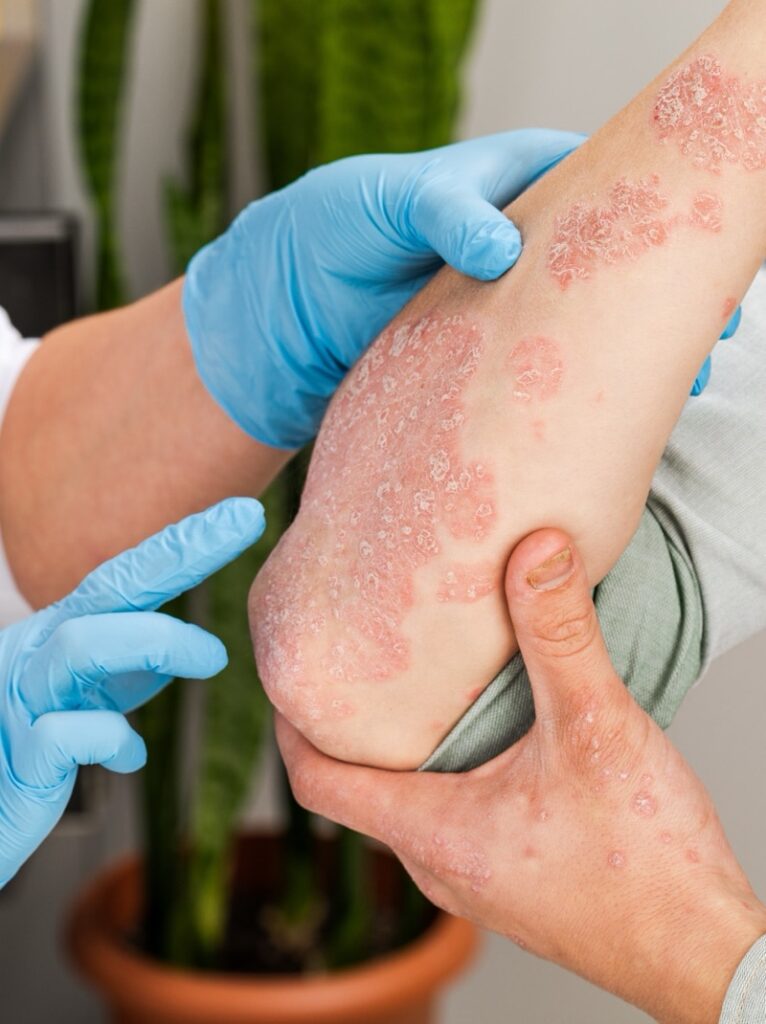
Psoriasis is an autoimmune condition that puts your skin on fast-forward. Cells that should take about a month to reach the surface pile up in a matter of days, building the thick, silvery-scaled plaques you can see and feel. Plaque psoriasis is the most common form, showing up on the elbows, knees, scalp, and lower back.
Flares get set off by stress, illness, injury to the skin, certain medications, and cold dry winters—which Denver has plenty of. It is not contagious; no one can catch it from you. Psoriasis is also linked to psoriatic arthritis, so if your joints ache, swell, or feel stiff in the morning, tell us and get them checked early.
How Is Psoriasis Treated?
There is no single psoriasis treatment that fits everyone. We match therapy to how much skin is involved, where the plaques are, and how much psoriasis is affecting your life—then adjust until your skin is clear or close to it.
- Topical therapy – Prescription corticosteroids and vitamin-D analogs that flatten plaques and calm scale
- Phototherapy – Narrowband UVB in controlled doses, the part of sunlight that helps without the burn
- Systemics and biologics – Oral medications and targeted injectables for moderate-to-severe psoriasis
Treatment Options
Modern Treatment. Calmer, Clearer Skin.
Psoriasis looks different on every patient—a few stubborn patches for one person, widespread plaques and a flaking scalp for another. We start with the least invasive option that will actually work for your severity, and move up without dragging it out if it doesn’t.
Prescription Topicals
Phototherapy
Systemic Medications
Biologic Therapy
Scalp-Specific Care
Have Questions About Psoriasis? Ask Ava
Our Team
20+ Years of Denver Skin Care
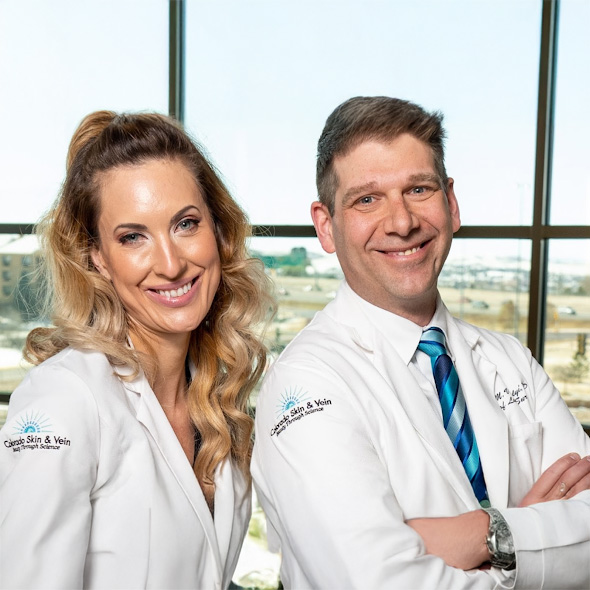
The team at Colorado Skin & Vein, led by David Verebelyi, MD, RVT, and Christina Jordan, FNP, CANS, has cared for Denver-area skin for more than two decades—including chronic conditions like psoriasis that need a long-term plan, not a one-time fix.
You see the same dermatology providers visit after visit, which matters when treatment has to be tuned over months and years rather than a single appointment.
- Double board-certified physician
- Experienced dermatology provider team
- Fellow & Instructor, American Society for Laser Medicine and Surgery
- Full range of psoriasis therapy, from topicals to biologics
- Two decades treating chronic skin conditions in Denver
Frequently Asked Questions
Common Questions About Psoriasis
Is psoriasis contagious?
No. Psoriasis is not contagious. You cannot catch it from someone else and you cannot pass it to anyone, no matter how close the contact. It comes from an overactive immune system, not an infection.
Is psoriasis an autoimmune disease?
Yes. Your immune system mistakenly speeds up skin cell production, so cells that should take about a month to surface pile up in days and form plaques. That same immune activity can affect joints, which is why we ask about joint pain and screen for psoriatic arthritis.
Can psoriasis be cured?
Psoriasis is controlled, not cured. That said, modern treatment routinely gets patients to clear or almost-clear skin and keeps them there. For day-to-day life, that is the goal we are aiming at.
What triggers a psoriasis flare?
Stress, infections and illness, injury to the skin such as cuts or sunburn, certain medications, smoking, and cold dry weather. Denver winters are a common culprit—low humidity plus indoor heat strips the skin barrier exactly when psoriasis is most reactive.
Are biologics covered by insurance?
Usually, yes. Most plans cover biologics for moderate-to-severe psoriasis once prior authorization is approved. Our team handles the paperwork and documentation, so you are not the one chasing the approval.
Do I need a referral to be seen?
No referral is needed. Request an appointment online or call us directly, and we can often get you in this week.
What is the difference between eczema and psoriasis?
Both are itchy and inflamed, but psoriasis plaques are thicker, more sharply bordered, and topped with silvery scale, favoring elbows, knees, scalp, and lower back. Eczema is usually less defined and shows up in skin folds. If you are not sure which you have, see our eczema and dermatitis page—or let us take a look.
Does sunlight help psoriasis?
Sometimes. The UVB in natural sunlight can improve plaques, which is exactly why phototherapy works. A sunburn does the opposite and can set off a flare. At Colorado altitude that line is easy to cross, so controlled in-office light therapy is far safer than treating yourself outdoors.
How long does psoriasis treatment take to work?
Topicals often calm scale within a few weeks. Phototherapy builds over one to two months of regular sessions. Biologics can produce major clearing in two to three months, and some patients see improvement sooner.
Can psoriasis affect my nails?
Yes. Pitting, crumbling, thickening, and lifting from the nail bed are common. Nail involvement also raises the odds of psoriatic arthritis, so it is worth mentioning—nail psoriasis tends to respond best to systemic or biologic treatment.