
Actinic Keratosis
Treatment in Denver
Rough, scaly patches on sun-exposed skin are precancers worth taking seriously — and treating them takes minutes. Cryotherapy at your first visit, and surveillance that keeps you ahead of the next ones.



Understanding Actinic Keratoses
What Actinic Keratoses Are — and Aren't
An actinic keratosis is a precancer, not a cancer. It is a small patch of sun-damaged skin — rough, dry, often easier to feel than to see — where the cells have begun to change. A modest percentage of untreated lesions go on to become squamous cell carcinoma, and there is no reliable way to know in advance which ones will. That is why treating them early is standard care rather than a precaution.
They appear after decades of sun, usually on the scalp, face, ears, forearms and the backs of the hands, and most often in fair-skinned patients past forty. At 5,280 feet, UV exposure is roughly 25 percent stronger than at sea level — which is why Colorado skin tends to grow them earlier, and grow more of them.
Actinic keratoses are a maintenance condition. Most patients return two or three times a year for a spot check and a touch-up, and that rhythm is normal rather than a sign that something went wrong.
How Are Actinic Keratoses Treated?
Which approach we use depends on how many spots you have and where they sit. Your dermatology provider decides at your visit — and in most cases treats them right then, while you are still in the chair.
- Confirm each spot – Every rough patch is examined, with dermoscopy or a biopsy when a lesion warrants it
- Treat what is there – Cryotherapy spot by spot, or field treatment when a whole zone is involved
- Stay ahead of the next ones – Scheduled skin checks two or three times a year catch new lesions early
Evidence-Based Care
Treat the Damage. Watch the Skin.
Actinic keratoses are precancers, so examining and treating them is medically necessary care rather than a cosmetic service. Visits and treatment are typically billed to your insurance, and our front desk verifies your benefits ahead of the visit — see Derm Pricing & Insurance for how coverage works.
Cryotherapy
Liquid nitrogen applied directly to each lesion for a few seconds. No cutting, no stitches, and no numbing needed for most treatments, and several spots can be handled at the same visit. The treated spot stings briefly, then scabs and flakes away over a week or two.
Field Treatment
When a scalp, face, or forearm carries lesions that have not surfaced yet, treating one spot at a time misses them. Topical field courses run at home, and photodynamic therapy treats the zone in the office with a light-activated solution.
Dermoscopy & Biopsy
Not every rough spot is an actinic keratosis. Ambiguous lesions are examined with dermoscopy, and anything that looks beyond a precancer is biopsied before it is treated rather than frozen and forgotten.
Surveillance & Skin Checks
Scheduled full-body skin checks at set intervals find new spots while they are still quick to treat. Most patients settle into two or three visits a year, and the next one is on the calendar before you leave.
Sun Protection Planning
You cannot undo the sun you already had, but you can slow the pace of new lesions. Daily broad-spectrum sunscreen, a wide-brimmed hat for the scalp and ears where lesions are hardest to see, and real caution at altitude and on snow, where UV is far stronger than most people assume.

Questions About Sun Damage & Precancers? Ava Has Answers
Our Team
20+ Years of Denver Skin Care
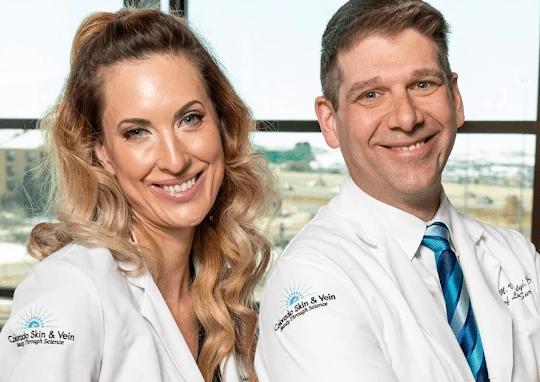
- Experienced dermatology provider team
- Every spot examined before it is treated
- Dermoscopy used whenever a lesion needs a closer look
- Most treatment completed the same visit you are seen
- Medically necessary care billed to insurance
Common Questions
Actinic Keratosis FAQ
Are actinic keratoses cancer?
No. An actinic keratosis is a precancer — sun-damaged skin that has begun to change but has not become cancer. A modest share of untreated lesions go on to become squamous cell carcinoma, and there is no way to predict which ones will, so treating them early is the standard approach rather than an overreaction.
What happens if I ignore them?
Many actinic keratoses stay the same for years, some resolve on their own, and a small share turn into squamous cell carcinoma. The difficulty is that no one can tell in advance which is which. Treating a rough spot takes seconds; treating a skin cancer means a surgical excision and a scar. That difference is the whole argument for handling them early.
Does treatment hurt?
Cryotherapy stings for a few seconds while the spot is frozen, then settles into a mild ache that fades quickly. No numbing is needed for most treatments. Field treatments are painless to apply, but they do bring redness, tenderness and peeling over the following days while the damaged cells clear.
How many visits will I need?
Individual spots are usually handled in one visit. But actinic keratoses are a maintenance condition rather than a one-time fix: if your skin has grown them once, it will likely keep producing them. Most patients settle into two or three visits a year for a spot check and a touch-up, and that pattern is normal.
Is treatment covered by insurance?
Yes, in nearly all cases. Because actinic keratoses are precancers, examining and treating them is medically necessary care rather than a cosmetic service, and it is typically billed to your insurance. We accept most major plans and verify your benefits before the visit. See Derm Pricing & Insurance for how we handle coverage.
What is the difference between an actinic keratosis and an age spot?
An age spot — a solar lentigo — is flat, evenly brown and smooth to the touch. An actinic keratosis is rough, dry and scaly, often pink or skin-colored, and you can usually feel it before you can clearly see it. Age spots are harmless. Actinic keratoses are precancers. When a spot is ambiguous, your dermatology provider examines it with dermoscopy and biopsies anything that warrants it.
What is field treatment, and what is PDT?
Field treatment treats an entire sun-damaged zone rather than one lesion at a time, which matters when a scalp or forearm carries lesions that have not surfaced yet alongside the ones you can see. Some field treatments are topical courses done at home. Photodynamic therapy is the in-office version: a light-activated solution is applied to the area, left to absorb, then activated with a specific wavelength of light.
Can I prevent new ones?
Partly. You cannot undo the sun you already got, and that exposure is what drives new lesions. What you can do is slow the pace: daily broad-spectrum sunscreen, reapplied on long days outdoors; a wide-brimmed hat, which covers the scalp and ears where lesions are most common and hardest to see; and real caution at altitude and on snow, where UV is far stronger than most people assume. Patients who take this seriously generally need fewer touch-ups.
Will the spots come back?
A treated spot generally clears and does not return. New ones keep appearing in the same sun-damaged skin, though — that is the nature of the condition, not a failure of the treatment. Occasionally a thick lesion needs a second freeze at a follow-up. Scheduled skin checks are what keep the count low.
Do I need a referral?
No. You can book directly with our dermatology team, and same-week appointments are usually available. Bring your insurance card, and tell us about any spot that has changed, bled or will not heal so it gets looked at first.