
Skin Checks & Mole Exams
in Denver
Most skin cancers are curable when they’re caught early. Our dermatology team performs full-body skin exams and mole evaluations with dermoscopy — and if a spot looks concerning, we can biopsy it during the same visit. A flat $150 cash mole check for self-pay, and appointments are usually available this week.
About Skin Checks
What Is a Full-Body Skin Exam?
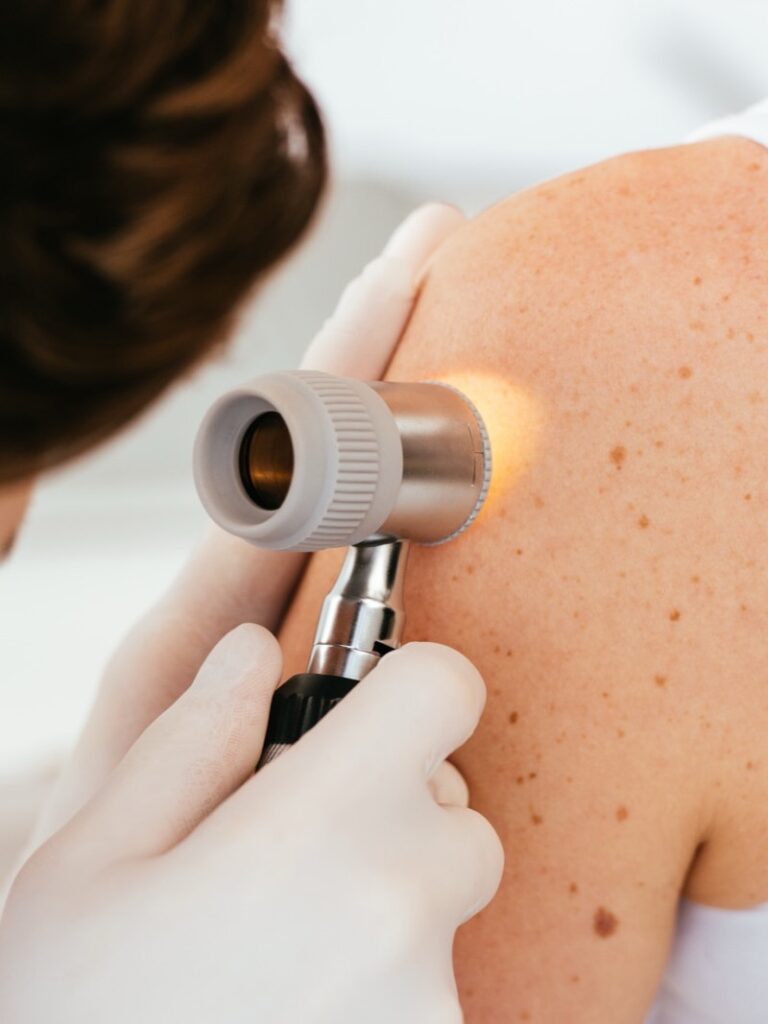
A full-body skin exam is a head-to-toe look at your skin by a trained dermatology provider — scalp to soles, including the spots you can’t check yourself. It takes about 15 to 20 minutes, nothing about it is invasive, and you leave knowing where you stand.
Your provider evaluates every mole and lesion, then uses a dermatoscope — a handheld magnifier with polarized light — on anything that looks unusual. Dermoscopy reveals pigment patterns and vessel structures below the surface that the naked eye simply cannot see. That’s how early melanoma gets identified while it’s still highly treatable.
If a spot is suspicious, we don’t send you elsewhere and we don’t make you wait. We can biopsy it during the same visit under local anesthetic, and pathology results come back in a matter of days. Colorado gives you every reason to stay on top of this: at 5,280 feet, UV exposure is roughly 25% stronger than at sea level, and our state consistently ranks above the national average for melanoma.


Early Detection Saves Lives
The ABCDEs
of Skin Cancer
Know the difference between a mole and melanoma
Check your skin once a month. If a spot matches any one of the five signs below, have it evaluated by a medical provider — melanoma found early is almost always curable.
Asymmetry
Draw an imaginary line through the middle. On a healthy mole the two halves mirror each other. If one half doesn’t match the other, take note.
Border
Normal moles have a smooth, clearly defined edge. Melanoma edges tend to be ragged, notched, scalloped, or blurred where they fade into surrounding skin.
Color
A healthy mole is one consistent shade. Be cautious of uneven coloring — multiple browns and blacks, or patches of pink, red, white, or blue within the same spot.
Diameter
Melanomas are often wider than 6 mm — about the size of a pencil eraser — though they can be detected when smaller. Any spot that keeps growing deserves a look.
Evolving
Change is the single most important warning sign. A mole that grows, darkens, thickens, itches, bleeds, or crusts — or a new spot that looks unlike your others — should be examined.
This chart is a self-screening guide, not a diagnosis. Illustrations are representative — real lesions vary widely in appearance across skin tones. When in doubt, get it checked.

Questions About a Mole or Spot? Ask Ava
Ava is our intelligent virtual assistant, available 24/7. Ask about a mole you’ve been watching, what happens during a full-body skin check, what a biopsy actually involves, or how our $150 cash mole check works. Clear, helpful answers on your schedule — no appointment needed.
Causes and Risk Factors
What Raises Your Skin Cancer Risk?
Anyone can develop skin cancer, but some people carry considerably more risk than others. Knowing where you land tells you how often you should be checked — and living in Colorado moves nearly everyone up a notch.
- Sun Exposure – Cumulative UV damage and blistering sunburns are the single biggest driver of skin cancer risk.
- Colorado's High-Altitude UV – At 5,280 feet, UV exposure is roughly 25% stronger than at sea level, and snow reflects even more of it back at you.
- Fair Skin – Light skin, light eyes, red or blond hair, and skin that burns instead of tanning all increase risk.
- Family or Personal History – A parent, sibling, or child with melanoma — or any prior skin cancer of your own — significantly raises your odds.
- Many Moles – More than 50 moles, or moles that look irregular (atypical nevi), means more spots that need watching.
- Immunosuppression – Transplant medications, chemotherapy, or immune conditions make skin cancers both more likely and more aggressive.
- Tanning Beds & Age – Indoor tanning before age 35 sharply increases melanoma risk, and risk climbs steadily as you get older.
Skin Exam & Mole Evaluation Services
At Colorado Skin & Vein, it all happens in one place. Our dermatology team examines, magnifies, samples, and removes — so you leave with answers instead of another appointment somewhere else.
Full-Body Skin Exam
A head-to-toe check of every mole and lesion, scalp to soles, with dermoscopy on anything that looks unusual. About 15 to 20 minutes, no downtime, no preparation needed.
Dermoscopy
A handheld dermatoscope magnifies a spot and cuts through surface glare, revealing the pigment and vessel patterns underneath. It is how early melanoma gets identified before it is obvious to the naked eye.
Skin Biopsy
If a spot looks concerning, we sample it during the same visit under local anesthetic. It takes minutes, you go home with a small bandage, and pathology results come back in a matter of days.
Excision & Growth Removal
Confirmed or suspicious lesions are removed completely with clear margins right in our office. The same approach handles benign growths you simply want gone.
Common Questions
Your Skin Check Questions Answered
How often should I get a skin check?
Once a year is the baseline for most adults. Go more often — every six months, or as your provider recommends — if you have a personal or family history of skin cancer, more than 50 moles, atypical moles, fair skin that burns easily, or a history of blistering sunburns or tanning beds.
Living in Colorado nudges nearly everyone toward the annual exam. At 5,280 feet, UV exposure is roughly 25% stronger than at sea level, and that adds up over years of hiking, skiing, and time outdoors.
What happens during a full-body skin exam?
You change into a gown and your dermatology provider examines your skin head to toe — scalp, ears, back, between the toes, all the places you can’t reasonably check yourself. Anything unusual gets a closer look through a dermatoscope, a handheld magnifier with polarized light.
The whole visit takes about 15 to 20 minutes. Nothing is invasive, and you’ll know before you leave whether anything needs further attention.
Does insurance cover skin checks?
In most cases, yes. An exam for a suspicious mole, a changing spot, or a personal or family history of skin cancer is a medical visit and gets billed to your insurance. We accept most major plans.
If you’re paying out of pocket, or you just want a single spot evaluated, we offer a flat $150 cash mole check — one clear price, no surprise billing.
What happens if you find something?
First we look at it under dermoscopy. If it still looks concerning, we biopsy it during the same visit under local anesthetic — no second appointment, no referral out. Pathology results come back in a matter of days.
From there you get a clear plan. Benign spots may just need monitoring. Confirmed or suspicious lesions are excised with clear margins in our office, and the rare case that needs a specialized surgical approach gets a direct referral.
Do I need a referral to be seen?
No. You can book a skin check directly with our office — no referral and no primary-care visit first. Appointments are usually available within the same week.
Bring a list of any spots you’ve been watching, and photos if you have them. A spot that has visibly changed over a few months is exactly what we want to see.
Denver's Trusted Skin Experts
For 20 years, Denver-area patients have trusted us with their skin. You get an experienced provider who takes the time to look carefully, transparent pricing before anything happens, and answers in days — not weeks.