Appointments Available This Week

Medical Melasma Treatment
in Denver

The brown patches that laser alone cannot fix start with medicine. Our dermatology team treats melasma as the chronic condition it is — prescription therapy, hormone awareness, and disciplined sun protection, adjusted over time rather than promised as a one-visit result.
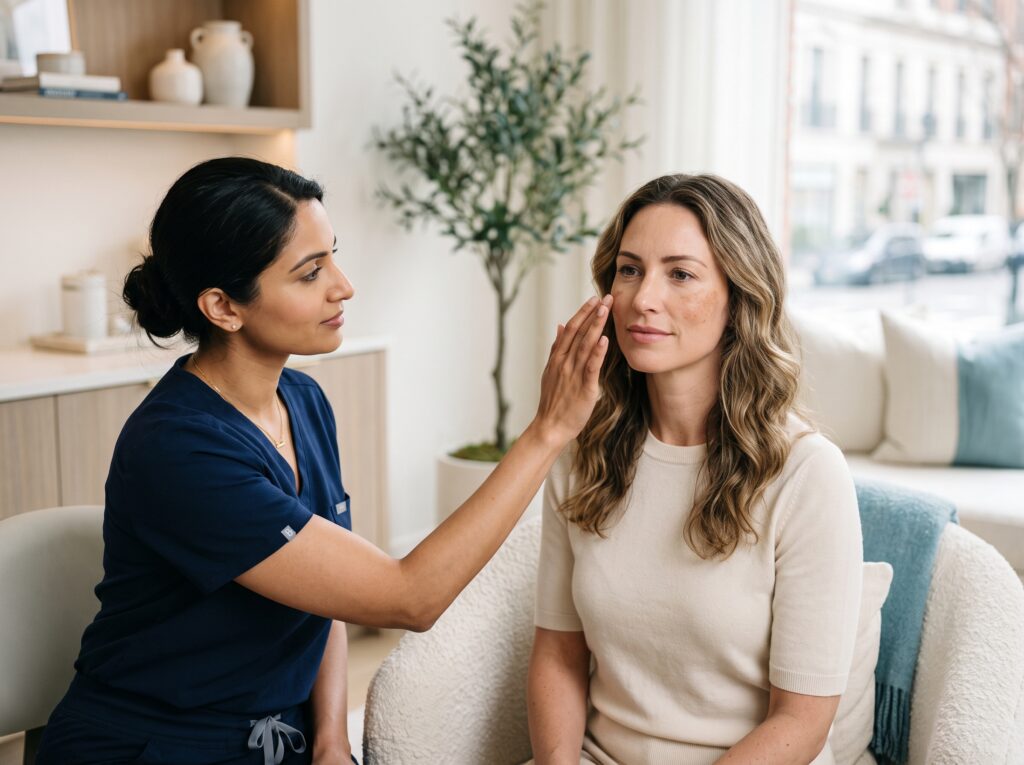

Medical melasma consultation with a dermatology provider
Leading Medical Certifications
AAFP
ARDMS
Plastic surgical nursing certificate board (psncb)
american society for laser medicine and surgery
Understanding Melasma

Understanding Melasma

Melasma happens when the pigment-producing cells in your skin over-respond. Ultraviolet light, heat, and hormones all push them to make more melanin than they should, and the result is symmetric brown to gray-brown patches — most often across the cheeks, the forehead, the upper lip, and the bridge of the nose.

It is not sun damage from a single burn, and it is not something you caused. Melasma is a chronic pigment condition with a strong hormonal component, which is why it so often appears during pregnancy, after starting birth control or hormone therapy, and in people with deeper skin tones. Heat matters as well: hot yoga, saunas, and long days outdoors can drive pigment even when you have not burned.

Denver is hard mode for melasma. Ultraviolet exposure is roughly 25 percent stronger at our altitude than at sea level, and we get close to 300 sunny days a year. That combination means tinted mineral sunscreen is not a summer habit here — it is a daily requirement, worn near windows and in the car as much as on the trail.

We will be straightforward with you about the goal. Melasma is managed, not cured. Treatment lightens the pigment that is there, and consistent control is what keeps it light. Patients who understand that from the start do better than patients who were promised a permanent fix.

How Is Melasma Treated?

Medicine first. Prescription lightening agents and retinoids do the work that over-the-counter brighteners cannot, and photoprotection is what makes any of it hold. Devices have a role in resistant pigment, but melasma is provoked by heat and light — so a device is considered only after medical control is established, never as a starting point. Your plan is built around your skin tone, your hormonal picture, and how your pigment has behaved so far.

Prescription First

Lighten the Pigment. Then Keep It Light.

No two cases of melasma respond the same way — depth of pigment, skin tone, and hormonal drivers all differ. We start with the prescription regimen most likely to lighten what is already there, then move you onto maintenance so the result holds. Expect months rather than weeks, and expect the plan to be adjusted along the way.

Prescription Hydroquinone Regimens

The gold-standard lightening agent, prescribed at medical strength and cycled the way it is meant to be — on for a defined course, then off. Supervision is the whole difference here: used correctly it is highly effective, and used indefinitely without guidance it is not.

Tretinoin & Combination Creams

Retinoid-driven cell turnover moves pigmented cells along and helps the other actives reach where they need to work. Often prescribed as triple-combination therapy, which pairs a retinoid, a lightening agent, and an anti-inflammatory in a single compounded cream.

Azelaic & Non-Hydroquinone Options

Azelaic acid, cysteamine, and similar agents give us effective options for maintenance phases, for skin that does not tolerate stronger actives, and for patients who are pregnant or nursing and need a plan that stays safe throughout.

Oral Tranexamic Acid

The newer, evidence-backed option for melasma that has not responded to topicals alone. It is taken by mouth at low dose, and we review your clotting and medication history before prescribing it and monitor you while you are on it.

Photoprotection Strategy

Tinted mineral sunscreen with iron oxides — which block the visible light that clear sunscreen misses — plus hats, window awareness, and heat management. This is the treatment nothing else works without, and we will be specific about what to use.

Considering laser for stubborn melasma? Our laser melasma treatments →
ava ai assistant

Have Questions About Melasma? Ask Ava

Wondering whether your patches are melasma or another kind of pigmentation, which prescription options are safe during pregnancy, or how long treatment takes to show? Ava, our skin health assistant, gives instant, personalized answers about melasma and pigment concerns — available 24/7.
Our Team

20+ Years of Medical Skin Care
Aesthetic Treatements

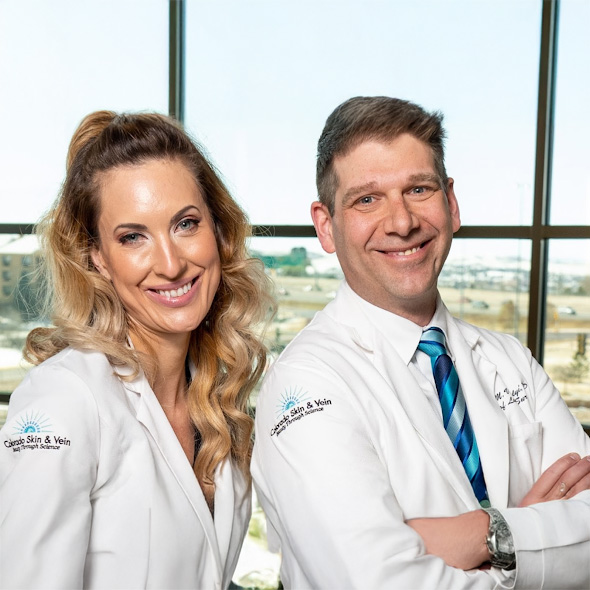
The team at Colorado Skin & Vein, led by David Verebelyi, MD, RVT, and Christina Jordan, FNP, CANS, has been caring for Denver-area skin for over two decades — treating pigment conditions like melasma alongside advanced medical and vascular dermatology.

Pigment rewards experience. Knowing which strength to start, when to cycle off, which patients are candidates for oral tranexamic acid, and when a treatment is more likely to darken melasma than lighten it is the difference between a result that holds and one that rebounds.

Frequently Asked Questions

Common Questions About Melasma

Will my melasma ever go away completely?
Honestly, for most people the goal is control rather than cure. Melasma is a chronic condition, and the pigment cells behind it stay reactive to light and hormones even after the patches fade. What treatment can do is lighten the pigment substantially and keep it that way — many patients reach a point where their melasma is not something other people notice. Stopping treatment and sun protection is what brings it back.
Used the way it is prescribed, yes. Hydroquinone has decades of clinical use behind it and remains the most effective lightening agent available. The concerns you may have read about come from unsupervised, continuous use over long stretches of time. We prescribe it in defined cycles, check your progress, and move you onto a maintenance agent when it is time to come off.
We build a different plan. Hydroquinone, tretinoin, and oral tranexamic acid are not used during pregnancy or nursing. Azelaic acid is well tolerated and genuinely effective, and rigorous photoprotection does a great deal on its own. Pregnancy-related melasma also fades on its own for some patients once hormones settle, so we often focus on protecting your skin and holding steady until then.
Usually one of three things: sun or heat exposure crept back up, a hormonal change happened, or maintenance treatment stopped once the skin looked clear. Melasma returning is not a sign that treatment failed — it is how the condition behaves. We adjust the regimen and restart control rather than starting over from the beginning.
Yes, and this is the piece patients are most surprised by. UVA passes straight through window glass, and visible light drives melasma pigment as well. That is why we recommend a tinted mineral sunscreen containing iron oxides rather than a clear one, worn every day regardless of the weather or whether you plan to be outside.
For melasma, yes, and the difference is significant. Over-the-counter brighteners are limited by regulation to concentrations that will not move established pigment much. Prescription regimens combine agents at medical strength and are matched to your skin tone, which matters a great deal — the wrong product on deeper skin can leave pigmentation worse than it started.
It is an oral medication originally used to reduce bleeding that turned out to interrupt one of the pathways driving melasma pigment. At the low doses used for melasma it has become a well-supported option for patients whose pigment has not responded to creams alone. It is not right for everyone — we review your clotting history, medications, and risk factors before prescribing it, and monitor you while you are taking it.
After medical control, not before. Melasma reacts to heat and light, so a device used on uncontrolled pigment can darken it rather than clear it. Once prescription therapy and photoprotection have the pigment stable and something resistant remains, treating it with a device becomes a reasonable conversation. Our practice offers that as well — you can read about our laser melasma treatments.
Often not, and we would rather tell you that upfront. Most plans consider melasma a cosmetic concern and do not cover the prescriptions or the visits aimed at treating it. There is a meaningful exception: an evaluation of changing or unexplained pigmentation is a medical visit, and that is frequently covered. We will tell you which category your visit falls into before anything is billed.
No referral is needed. You can book directly with our dermatology team, and we usually have appointments available the same week.

Denver's Trusted Skin Experts

For over 20 years, Denver-area patients have trusted us with the skin concerns that do not resolve on their own. Melasma rewards experience, consistency, and a provider who will actually follow up — which is exactly what you get here.

20+ years treating Denver skin

Experienced dermatology provider team

Transparent cash pricing

Personalized treatment plans that fit your life

Same-week appointments available

Most insurance plans accepted

Schedule Your Melasma Consultation

Danielle Killingsworth, NCMA, Aesthetics Coordinator at Colorado Skin & Vein in Denver

Danielle Killingsworth

NCMA, Aesthetics Coordinator

Danielle is a Colorado native who brings more than 22 years of experience in the medical field. Throughout her career she has developed a diverse clinical background across infectious disease, general surgery, and pain management — giving her a well-rounded understanding of patient care and of what it takes to create a safe, comfortable, and personalized experience.

As Aesthetics Coordinator at Colorado Skin & Vein, Danielle combines that clinical knowledge with a genuine passion for aesthetics. She is dedicated to helping patients feel confident, informed, and supported throughout their aesthetic journey, from the initial consultation through treatment and follow-up care.

She believes one of the most rewarding parts of her career is building meaningful relationships with patients and helping them look and feel their very best.

Outside of work, Danielle enjoys spending time with her family, including her four boys, getting lost in a good book, and working in her garden. Fun fact: she is a dedicated Dallas Cowboys fan.

Nikki Moyta, Operations Director at Colorado Skin & Vein in Denver

Nikki Moyta

Operations Director

For over 26 years, Nikki has dedicated her career to the dermatology and aesthetics industry, building her experience from the ground up — starting in a patient scheduling call center, moving to the front desk, and rising to executive leadership overseeing multiple providers and locations.

Originally from Pittsburgh, she moved to Orlando before starting 10th grade and later attended Seminole State College of Florida. Her career in dermatology began in 2002, scheduling appointments for a multi-location practice. She grew quickly within the organization, moving into front-desk and checkout roles before being promoted to Office Manager in 2008. In 2012, her leadership and operational expertise led the CEO to seek her out for an expanded role overseeing multiple providers and locations — a position she held through 2022.

Outside of her professional career, Nikki is passionate about giving back to the community:

  • Community outreach
  • Voted “Cheerleader of the Practice”
  • 1st Place Winner — Miles for Melanoma

With a career built on leadership, dedication, and a genuine passion for patients and the aesthetics industry, she is excited to bring her experience and enthusiasm to the Colorado community. When she is not in the office, you can find Nikki with her Siberian husky, Compass, somewhere on top of a mountain.

Betina Lacson, RVT at Colorado Skin & Vein in Denver

Betina Lacson

RVT

Betina graduated from the Cardiovascular Technology Program at Grossmont College in California in 2020, and brings more than six years of experience in the duplex world of venous insufficiency. Much of her career has centered on superficial vein mapping and assisting in surgery while providing attentive patient care.

At Colorado Skin & Vein, she assists with venous ablation procedures as well as ultrasound-guided sclerotherapy. She is committed to quality care at every stage — from the initial consultation, through surgery, to post-operative appointments — making sure each patient feels fully supported.

In her free time, Betina loves Kizomba dancing with her Afro-Latin dance community, and can often be found at electronic dance music shows in different cities. If you are feeling generous, she will happily accept a karaoke room or an iced Thai milk tea.

Brooke Owens, PA-C, MPAS at Colorado Skin & Vein in Denver

Brooke Owens

PA-C, MPAS

Brooke Owens, PA-C, MPAS is a compassionate Physician Assistant who brings a strong clinical foundation, exceptional attention to detail, and a patient-centered approach to Colorado Skin & Vein.

Prior to joining the practice, Brooke spent several years in pediatric primary care, caring for patients with a wide range of acute and chronic conditions. She became known for her thorough evaluations, thoughtful clinical decision-making, and ability to build lasting relationships with patients and their families. That experience strengthened her diagnostic expertise while reinforcing the importance of listening carefully, educating patients, and creating individualized treatment plans.

Drawn to the unique blend of medicine, procedures, and patient transformation, Brooke was excited to move into vascular medicine and aesthetic care. She is passionate about helping patients improve not only their health but also their confidence — whether they are seeking treatment for vein disease, skin concerns, or cosmetic enhancements. By combining broad medical experience with advanced specialty training and a meticulous eye for detail, she delivers safe, effective, and personalized care.

Brooke believes the best outcomes begin with trust. She values taking the time to understand each patient’s goals, answer questions, and ensure they feel informed and comfortable throughout their care.

Angel Croce, Staff Manager at Colorado Skin & Vein in Denver

Angel Croce

Staff Manager

Angel has been in healthcare for more than 20 years. Her journey began in 2004, after her father suddenly passed away from a stroke. Losing him was a life-changing experience, and it inspired her to choose a career where she could help others and give patients and their families the care, compassion, and support they need during difficult times.

Throughout her career she has worked across cardiology, neurology, family practice, and urgent care — each experience helping her grow both personally and professionally. She now works in vascular care and aesthetics, where she enjoys building relationships with her patients, helping them understand their care, and making sure they feel comfortable and supported throughout their journey.

Outside of work, Angel is a proud mom of two. Family is incredibly important to her, and in her spare time she loves being outdoors with her husband and their two dogs — hunting, fishing, and enjoying Colorado.

For Angel, healthcare is more than a career — it is personal. What started as a way to honor her father’s memory has become more than two decades of caring for others, and she is grateful to keep doing something that means so much to her every day.