
Medical Melasma Treatment
in Denver
The brown patches that laser alone cannot fix start with medicine. Our dermatology team treats melasma as the chronic condition it is — prescription therapy, hormone awareness, and disciplined sun protection, adjusted over time rather than promised as a one-visit result.




Understanding Melasma
Understanding Melasma
Melasma happens when the pigment-producing cells in your skin over-respond. Ultraviolet light, heat, and hormones all push them to make more melanin than they should, and the result is symmetric brown to gray-brown patches — most often across the cheeks, the forehead, the upper lip, and the bridge of the nose.
It is not sun damage from a single burn, and it is not something you caused. Melasma is a chronic pigment condition with a strong hormonal component, which is why it so often appears during pregnancy, after starting birth control or hormone therapy, and in people with deeper skin tones. Heat matters as well: hot yoga, saunas, and long days outdoors can drive pigment even when you have not burned.
Denver is hard mode for melasma. Ultraviolet exposure is roughly 25 percent stronger at our altitude than at sea level, and we get close to 300 sunny days a year. That combination means tinted mineral sunscreen is not a summer habit here — it is a daily requirement, worn near windows and in the car as much as on the trail.
We will be straightforward with you about the goal. Melasma is managed, not cured. Treatment lightens the pigment that is there, and consistent control is what keeps it light. Patients who understand that from the start do better than patients who were promised a permanent fix.
How Is Melasma Treated?
Medicine first. Prescription lightening agents and retinoids do the work that over-the-counter brighteners cannot, and photoprotection is what makes any of it hold. Devices have a role in resistant pigment, but melasma is provoked by heat and light — so a device is considered only after medical control is established, never as a starting point. Your plan is built around your skin tone, your hormonal picture, and how your pigment has behaved so far.
- Quiet the pigment – Prescription therapy lightens existing patches over a supervised course
- Address the trigger – Hormones, heat, and daily UV exposure get reviewed and planned around
- Hold the result – A maintenance regimen and rigorous photoprotection keep melasma from returning
Prescription First
Lighten the Pigment. Then Keep It Light.
No two cases of melasma respond the same way — depth of pigment, skin tone, and hormonal drivers all differ. We start with the prescription regimen most likely to lighten what is already there, then move you onto maintenance so the result holds. Expect months rather than weeks, and expect the plan to be adjusted along the way.
Prescription Hydroquinone Regimens
The gold-standard lightening agent, prescribed at medical strength and cycled the way it is meant to be — on for a defined course, then off. Supervision is the whole difference here: used correctly it is highly effective, and used indefinitely without guidance it is not.
Tretinoin & Combination Creams
Retinoid-driven cell turnover moves pigmented cells along and helps the other actives reach where they need to work. Often prescribed as triple-combination therapy, which pairs a retinoid, a lightening agent, and an anti-inflammatory in a single compounded cream.
Azelaic & Non-Hydroquinone Options
Azelaic acid, cysteamine, and similar agents give us effective options for maintenance phases, for skin that does not tolerate stronger actives, and for patients who are pregnant or nursing and need a plan that stays safe throughout.
Oral Tranexamic Acid
The newer, evidence-backed option for melasma that has not responded to topicals alone. It is taken by mouth at low dose, and we review your clotting and medication history before prescribing it and monitor you while you are on it.
Photoprotection Strategy
Tinted mineral sunscreen with iron oxides — which block the visible light that clear sunscreen misses — plus hats, window awareness, and heat management. This is the treatment nothing else works without, and we will be specific about what to use.
Considering laser for stubborn melasma? Our laser melasma treatments →

Have Questions About Melasma? Ask Ava
Our Team
20+ Years of Medical Skin Care
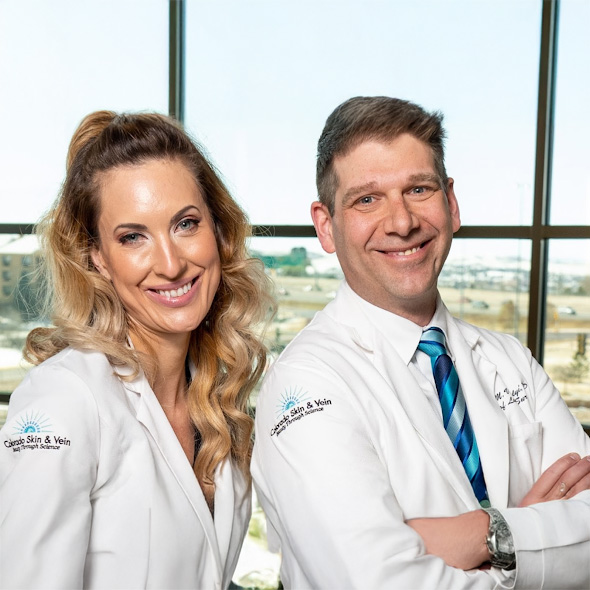
The team at Colorado Skin & Vein, led by David Verebelyi, MD, RVT, and Christina Jordan, FNP, CANS, has been caring for Denver-area skin for over two decades — treating pigment conditions like melasma alongside advanced medical and vascular dermatology.
Pigment rewards experience. Knowing which strength to start, when to cycle off, which patients are candidates for oral tranexamic acid, and when a treatment is more likely to darken melasma than lighten it is the difference between a result that holds and one that rebounds.
- Double board-certified physician
- Experienced dermatology provider team
- Fellow & Instructor, American Society for Laser Medicine and Surgery
- Medical dermatology for pigment conditions like melasma
- Most insurance plans accepted, including Medicare