
Hair Loss Treatment
in Denver
Thinning hair has causes, and most of them can be found. Our dermatology team evaluates men and women for the medical reasons behind hair loss, then treats the one that is driving yours. Appointments available this week.





Understanding Hair Loss
Understanding Hair Loss
Most hair loss is diagnosable. What looks like a single problem in the mirror is usually one of a handful of distinct conditions, and each responds to something different — which is why an evaluation comes before a prescription.
Androgenetic (pattern) hair loss is the most common form in both men and women, driven by genetics and follicle sensitivity to hormones. It progresses gradually and responds best to steady, long-term therapy. Telogen effluvium is diffuse shedding that follows a stressor — illness, surgery, rapid weight loss, childbirth, a medication change — and usually begins two to three months after the event. Alopecia areata is an autoimmune condition that produces smooth, well-defined patches and often responds quickly to targeted treatment. Traction and styling damage comes from sustained tension, heat, and chemical processing, and it is reversible when caught before the follicle scars.
Hair loss in women is common, frequently hormonal, and very treatable. The pattern differs from men’s: rather than a receding hairline, most women notice the part line widening, less weight in a ponytail, and more hair in the brush. Thyroid disease, iron deficiency, postpartum hormone shifts, and menopause all contribute, and each is worth testing for. Women are often told that thinning is simply age. In our experience it rarely is.
Timing matters more here than in almost any other area of dermatology. Follicles that are miniaturizing can be preserved; follicles that have scarred cannot be brought back. Early treatment protects the hair you still have, which is a far better outcome than trying to restore hair that is already gone.
Looking to remove unwanted hair instead? Laser hair removal is here.
How Is Hair Loss Treated?
Treatment follows the diagnosis. Once we know which process is driving your loss, we match therapy to it — topical, oral, injectable, or a combination — and we measure progress in photographs over months rather than in the mirror over days.
- Identify the cause – A scalp examination and targeted labs establish what is actually driving the loss
- Treat the mechanism – Topical, oral, and injectable options matched to your diagnosis, sex, and history
- Track the response – Standardized photographs at set intervals show what is working before you can feel it
Evidence-Based Care
Find the Cause. Keep the Hair.
No two patients lose hair for the same reason, and treating the wrong mechanism costs months you cannot get back. We start with an evaluation, then build the plan around what it shows. Evaluation of the medical causes of hair loss is covered by most insurance plans.
Evaluation & Lab Workup
A close examination of the scalp and hair shafts, with laboratory testing where it is indicated — thyroid function, iron and ferritin, and hormonal panels. Finding the driver comes first; everything else follows from it.
Topical Minoxidil Therapy
Prescription-strength topical regimens, applied consistently, with a realistic timeline attached. Shedding often increases briefly before it improves, and we tell you that in advance so you do not stop too early.
Oral Therapies
Finasteride, spironolactone, and low-dose oral minoxidil where appropriate, matched to your sex, medical history, and goals. We review the evidence and the trade-offs together before anything is prescribed.
Steroid Injections for Alopecia Areata
Targeted intralesional injections placed directly into affected patches. For autoimmune hair loss this is often the most direct way to restart growth, and regrowth is frequently visible within a few months.
PRP & Advanced Options
Platelet-rich plasma and other adjunctive therapies, presented with a clear account of what the evidence supports and where it is still thin. We will tell you when something is worth adding and when it is not.

Have Questions About Hair Loss? Ask Ava
Our Team
20+ Years of Medical Skin Care
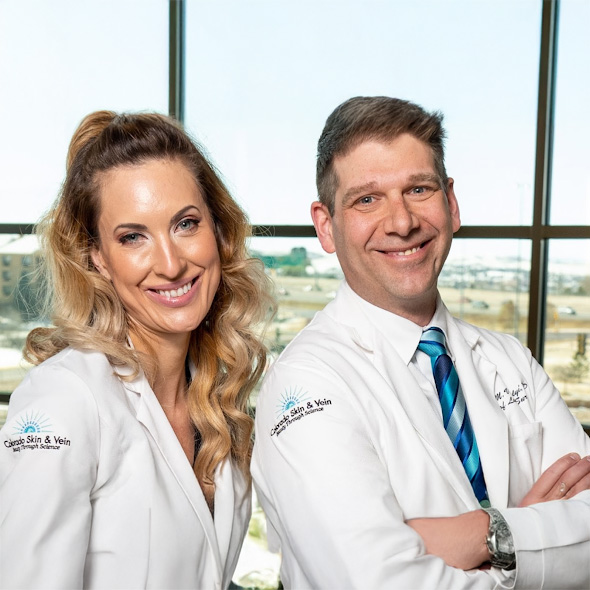
The team at Colorado Skin & Vein, led by David Verebelyi, MD, RVT, and Christina Jordan, FNP, CANS, has been caring for Denver-area skin and hair for over two decades — evaluating and treating hair loss alongside medical dermatology, advanced laser, and vascular medicine.
Hair loss rewards experience. Knowing which pattern points to a hormonal cause, when labs will change the plan, and when an injection will do more than a prescription is the difference between treating hair loss and simply watching it.
- Double board-certified physician
- Experienced dermatology provider team
- Fellow & Instructor, American Society for Laser Medicine and Surgery
- Medical evaluation and treatment for hair and scalp conditions
- Most insurance plans accepted, including Medicare
Frequently Asked Questions
Common Questions About Hair Loss
Is hair loss different in men and women?
The underlying biology overlaps, but the pattern and the workup differ. Men typically lose hair at the temples and crown in a recognizable progression. Women more often notice the part line widening and overall volume dropping while the frontal hairline stays intact. Women are also more likely to have a contributing medical cause — thyroid, iron, or hormonal — which is why laboratory testing is a routine part of the evaluation.
Is hair loss reversible?
It depends on the type, and we will be direct with you about which one you have. Telogen effluvium almost always recovers once the trigger resolves. Alopecia areata frequently regrows with treatment. Pattern hair loss is not cured, but it can be slowed and partially reversed with consistent therapy. Hair lost to scarring conditions does not return, which is the strongest argument for being seen early.
When should I worry about shedding?
Losing 50 to 100 hairs a day is normal. Come in if shedding has clearly increased for more than six to eight weeks, if you can see more scalp through your part or at the crown, if your ponytail has thinned noticeably, or if hair is coming out in defined patches. Sudden or patchy loss deserves prompt evaluation.
What labs are needed?
It depends on your history, but a typical workup includes thyroid function, iron studies with ferritin, and vitamin D. For women we often add hormonal testing, particularly alongside irregular cycles, adult acne, or excess facial hair growth. Labs are not always necessary — the scalp examination frequently tells us most of what we need to know.
How long until treatment shows results?
Plan on three to six months before any treatment can be judged fairly, because hair grows slowly and the follicle cycle is measured in months rather than weeks. Standardized photographs taken at your first visit make the difference clear later, when day-to-day comparison in the mirror will not.
Does insurance cover hair loss visits?
Evaluation of a medical cause is usually covered, including the office visit and laboratory testing for conditions such as thyroid disease, iron deficiency, or alopecia areata. Treatments considered cosmetic, platelet-rich plasma among them, are generally not covered. We will tell you which category your care falls into before anything is scheduled.
Is PRP worth it?
For some patients, yes. Platelet-rich plasma has reasonable evidence as an adjunct in pattern hair loss, particularly for patients already using topical or oral therapy, and it requires a series of sessions followed by maintenance. It is not a substitute for a diagnosis and it is not the right first step for everyone. We will say so plainly if it is unlikely to help you.
Alopecia areata — will it come back?
It can. Alopecia areata is an autoimmune condition that tends to arrive in episodes, and regrowth after treatment is not a guarantee against recurrence. Many patients have one episode and nothing further; others see occasional patches over the years. Treating each episode early gives the best chance of full regrowth.
Can menopause cause hair loss?
Yes. The decline in estrogen through perimenopause and menopause leaves follicles more sensitive to androgens, which is why many women first notice thinning in their late forties and fifties. It is a common and treatable pattern, and it is worth evaluating rather than accepting.
Do I need a referral?
No referral needed. You can book directly with our dermatology team, and we usually have appointments available the same week.